Governance · Delivery
Your Pilot Needs a Death Date
Without an expiration date, a pilot can keep running without earning the right to continue.
Shikhar Agarwal · November 2, 2026 · 5 min read
Recently, I had a conversation with a customer about an agentic AI pilot that was part of their ERP-next initiative.
The pilot started with plenty of visibility and enthusiasm. People were interested in what the technology could do, and there was a sense of momentum.
Over time, though, the attention began to fade. The pilot was still running, but the customer wasn't sure why interest around it had diminished.
As we talked, one detail stood out. The pilot had no defined end date.
There was no agreed point at which someone had to decide whether to continue, change direction or stop. The pilot kept running, even as the attention that had supported it began to disappear.
I left that conversation wondering how many pilots continue not because someone has decided they should, but because nobody has been required to decide otherwise.
The easiest decision is no decision
A pilot starts with a budget, a sponsor and a promise of what might be possible. It rarely starts with a clear agreement about when that promise must be judged.
Without that point, almost any progress can justify another month. The demonstration works. Another feature is added. The team needs more data. The next release might change things.
None of these is necessarily a bad reason to continue. But someone should have to make that case.
This is an old problem. Researchers studying runaway IT projects in the 1990s found that sunk costs could encourage decision makers to escalate their commitment. Money already spent becomes part of the argument for spending more.
AI hasn't invented that behavior. It has given us more opportunities to repeat it.
In 2025, S&P Global Market Intelligence reported that 42% of surveyed organizations were abandoning most of their AI initiatives before production, up from 17% the year before. On average, organizations abandoned 46% of their proofs of concept before production.
Those figures don't prove that pilots lack end dates. Nor is abandonment necessarily failure. Sometimes stopping is exactly the right result.
The problem is letting the decision arrive by accident.
And with AI agents, the consequences can extend beyond the pilot budget. Agents may retrieve data, call tools, update records or take actions within business workflows. A pilot that quietly continues may also retain access and permissions that were intended for an experiment.
The longer it runs without a deliberate decision, the easier it becomes to mistake continued activity for continued justification.
Flip the default
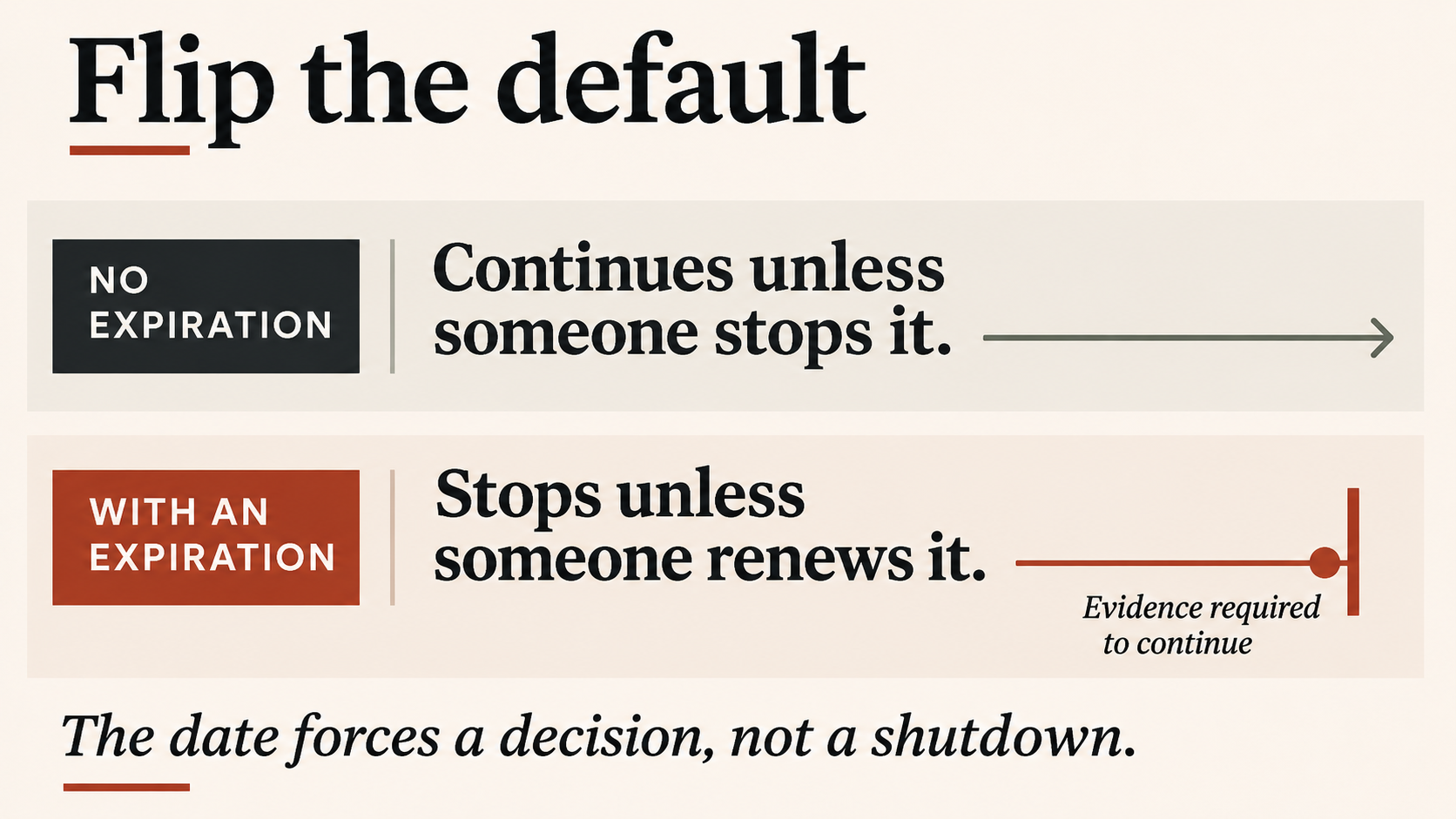
A pilot without an expiration date keeps running until someone decides to stop it.
A pilot with an expiration date reaches the end of its authorization. Continuing requires an explicit decision backed by evidence.
That changes who has to make the argument.
The date isn't an instruction to kill a useful experiment. It marks the expiration of the current agreement to run it.
On that day, the sponsor can approve the next stage, renew the pilot to answer a specific unresolved question, change its scope or stop. But continuation requires a decision. Another quarter cannot be the default simply because nobody objected.
An extension should come with a reason, new evidence to pursue and another expiration date. Otherwise, you've only moved the calendar.
The date forces a decision, not a shutdown.
Research on escalation of commitment offers reasons to be wary of open-ended investment. It does not establish that expiration dates prevent it. I would still make the expiration date a condition of starting a pilot, because it creates a moment when the evidence must be confronted.
And that evidence has to be agreed in advance. Otherwise, the expiration date becomes another meeting where everyone has a different definition of progress.
Five lines before the pilot starts
- The metric. What outcome is the pilot supposed to demonstrate? Choose a measure that matters beyond the demo.
- The threshold. What result is good enough to proceed, and what would tell you it isn't working?
- The expiration date. Put an actual date on the calendar. Not "when we have enough data."
- The decider. Name the person who must make the continuation decision.
- The production test. Identify the hardest thing that could prevent the pilot from scaling. Data access, security, reliability, support or operational ownership. Test it early.
For agentic pilots, define what the agent is allowed to do and the conditions that require its access to be suspended before the expiration date. A scheduled decision is no substitute for controls while an experiment is running.
These five lines won't guarantee a successful pilot. They will make it harder to keep one alive without answering what it was started to prove.
A clean stop is delivery too
People sometimes treat stopping a pilot as admitting failure.
I see it differently.
If a pilot demonstrates that an approach won't work, within the agreed time and against the agreed criteria, it has delivered something useful. It has prevented further investment in the wrong direction.
A technically impressive pilot that runs indefinitely without establishing whether it should scale may have delivered less.
And when a sponsor learns unexpectedly that a long-running pilot isn't going anywhere, the organization has spent more than money. It has spent trust. The next request for funding starts with a harder conversation.
A pilot should end with an answer, even if that answer is no.
A pilot doesn't have to succeed. It does have to end with a decision.
From the same thread
Frictionless Is Still the Promise
Customers were promised frictionless AI customer service. What many are getting is a smoother conversation, not a faster fix.
When the Seller Becomes the Advisor
Between May and July 2026, the companies that build the technology also became the ones paid to advise on it. I think that changes what a second opinion is worth.