Adoption · Delivery
Frictionless Is Still the Promise
Customers were promised frictionless AI customer service. What many are getting is a smoother conversation, not a faster fix.
Shikhar Agarwal · October 20, 2026 · 5 min read
A word typed in capital letters
Samuel Levine is the commissioner of New York City's Department of Consumer and Worker Protection. After a hotel stay he found charges he didn't recognize and couldn't find a phone number to call. What he found instead was a chat window. The bot had a friendly name and typing dots, and over 25 minutes it offered him discounts on another stay. At one point he typed a single word in capitals: HUMAN. The bot carried on.
People have been typing that word at customer service for a long time. What's different now is how much they were promised first.
Three stories, one pattern
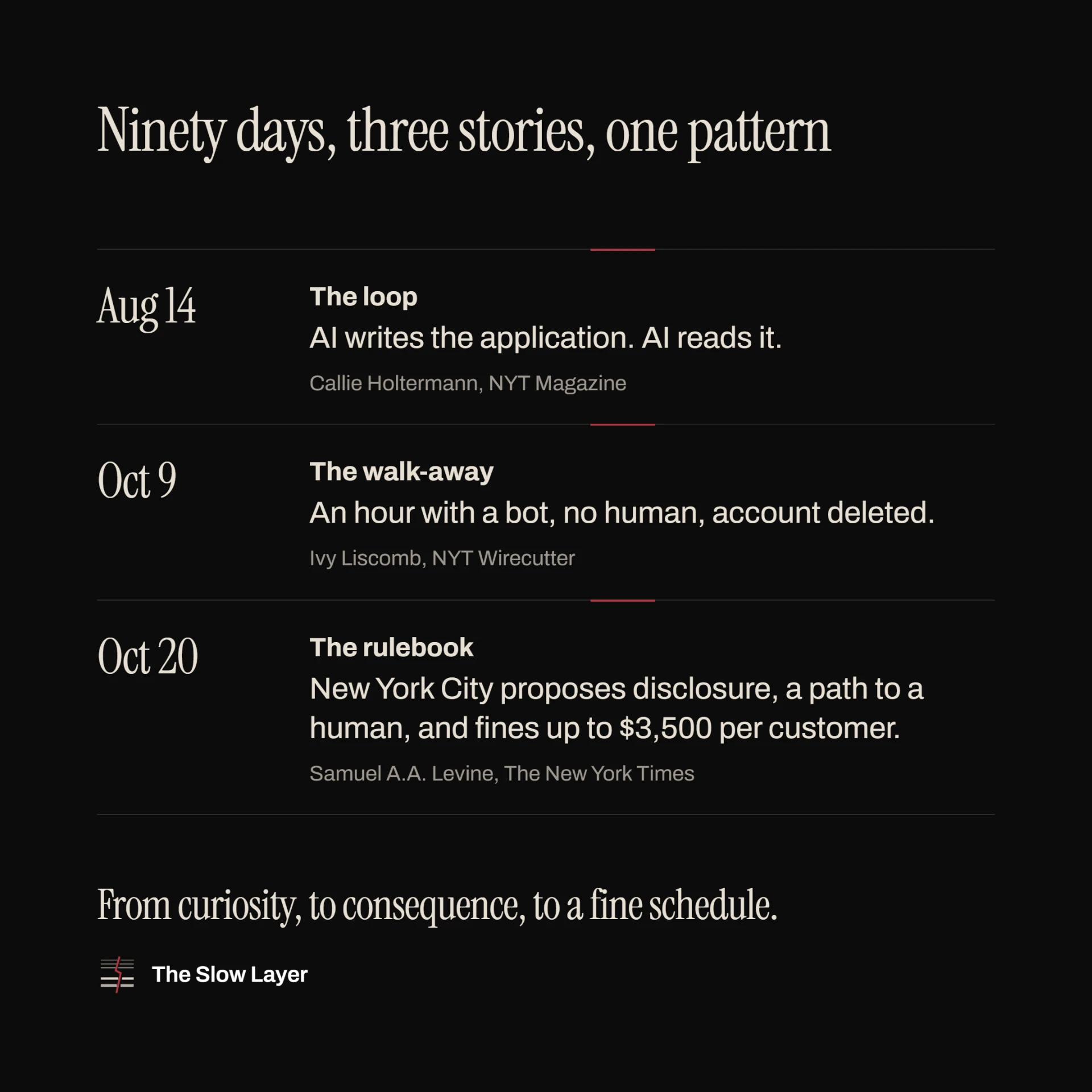
August: the loop. Callie Holtermann, writing in the New York Times Magazine, describes what she calls bot loops, where the people on both sides of an exchange hand their part to AI. One job applicant had chatbots write his applications while screening software read them. A telecom executive saw customers sending AI voice agents to argue with his company's AI service system. Her worry is that AI systems built on the same models miss each other's mistakes. Soheil Feizi of the University of Maryland describes them as "sharing the same blind spots."
October 9: the walk-away. Ivy Liscomb of Wirecutter spent more than an hour trying to cancel a Walmart delivery subscription that had no cancel button. The voice bot told her to reload the page or delete her account, and it turned down her requests for a person. She deleted her account. Her piece also notes that no US rule stops a company from leaving customer service entirely to AI.
October 20: the rulebook. Levine's column describes a New York City proposal that would require companies to say when you're talking to a chatbot and to make a human easier to reach. Fines would run from $525 for a first violation up to $3,500, per violation and per customer. He points out that the city has about 8.6 million residents. At that scale, the fines add up quickly.
Read in order, the three pieces move from curiosity, to consequence, to a fine schedule.
The bar moved before the product did
Human customer service was rarely a pleasure. Hold music, transfers, the agent who asks for the account number you just keyed in. Oren Bar-Gill, a law professor at NYU quoted in the Wirecutter piece, makes the same point: poor service existed well before AI.
So the old system rarely earned applause. The promise is what changed. For the past few years, customers have heard that AI would make service faster, more natural, available at any hour and free of the friction they'd learned to put up with. With that much marketing, believing it was reasonable. The expectation now follows the customer into each interaction, whoever or whatever is on the other end.
A person, a bot, or a bot with a person on standby gets graded on the same question: did that take less effort than it used to? I think that matters more than which one picks up.
Levine's 25 minutes show what happens when the answer is no. He suspected the chatbot was built to test how much friction customers would put up with, and how much information they'd hand over before giving up. I can't say whether that was the design. The suspicion alone is the cost. Once a customer believes the friction is deliberate, the deployment has lost the argument.
Resolution beats smoothness
The three stories show two failure modes. Holtermann's bot loops are smooth: the dialogue flows, follows the rules of conversation, and still lacks curiosity, empathy and actual experience. Liscomb's Walmart bot was sticky: it repeated calming phrases and lost track of her issue every few questions. Levine's sat somewhere between, with pleasantries, a menu and offers of discount codes.
The loop was smooth, the Walmart bot was sticky, and neither fixed the problem.
Smoothness describes how a conversation feels. Resolution describes what happens to the charge on the bill afterward. A pleasant exchange that leaves the charge in place has failed at the part the customer came for. The friction that matters sits between the problem and the fix, and a polished chat window doesn't shorten that.
This is where I'd push on the hype. Frictionless is still the promise, so measure it: the minutes, repeats and re-explanations between the problem and the fix.
The stage and the ground
I was at Community Summit in Nashville this year. The stage was full of AI stories that worked: demos, wins, numbers moving the right way. I'm not doubting those stories. They are also the ones that made it to a stage.
The pilot that stalled, the agent switched off after a month, the customer sent in circles for 25 minutes: stories like those rarely get told from a stage. That's understandable. Conferences tend to show the wins.
The three articles above show the rest of the footage. A commissioner typing HUMAN into a hotel chat window. A writer deleting her account because a bot wouldn't let her cancel it. AI systems talking to each other and missing the same mistakes. Both views are true at the same time, and the distance between them is a number I wish got reported.
That distance is the delivery gap. It's the part of the work that doesn't fit on a slide, and it's the part I spend my time on.
Questions to ask before you launch an AI customer service bot
Levine expects retailers to launch new chatbot assistants alongside their Black Friday sales, so this is a good moment to ask whoever is building it a few things before you sign off.
I'd start with the exit. Ask to see the path from the first message to a person, step by step, and try it yourself with the words a frustrated customer would type. If it takes a trick to find, most customers won't find it.
Then ask what counts as success. A conversation the bot closed is different from a problem that got solved, so ask for the resolution rate and for how often customers come back about the same issue within a week. Ask about the handoff too. Levine re-explained his problem to a system that seemed to have the details already, and Liscomb's bot lost her issue repeatedly. The person who picks up should see the transcript.
Last, ask who answers when it's wrong. Wirecutter notes that Air Canada paid damages after its bot misled a customer about bereavement fares, and that a German court preliminarily found Google liable for false statements in a Gemini overview. Put accountability in the contract.
The work after the launch
Building the demo is the quick part. A pilot that works while the build team watches is a start. The gap between what customers were promised and what they get closes, or stays open, in the months after go-live: tuning, escalation paths, ownership, measurement and a lot of unglamorous fixes.
I've spent my career on the delivery side of enterprise technology, and this is the layer that has decided which projects hold up. Three articles in ninety days say customers have noticed, and a city is putting a price on it.
Somewhere a customer is typing HUMAN into a chat window right now. Closing that gap is slower than shipping a bot, and it's the part worth doing.
Sources
- Samuel A.A. Levine, "Help! A Chatbot Hijacked My Customer Service Call," The New York Times, Oct. 20, 2026. www.nytimes.com/2026/10/20/opinion/mamdani-ai-rule-customer-service-doom-loop.html
- Ivy Liscomb, "AI Has Taken Over the Customer Service Industry. Here's How to Navigate It," NYT Wirecutter, Oct. 9, 2026. www.nytimes.com/wirecutter/advice/bad-ai-customer-service/
- Callie Holtermann, "Chatbots Are Pushing Us Toward a Post-Human Internet," The New York Times Magazine, Aug. 14, 2026. www.nytimes.com/2026/08/14/magazine/ai-chatbots-internet-communication-loops.html
From the same thread
What Is Actually New About the Forward Deployed Engineer
Four vendors committed about $9 billion in 2026 to putting engineers inside their customers. The role is mostly not new. I think two things about it are.
Trust Compounds One Commitment at a Time
Repayment happens on a schedule, and the schedule matters as much as the total.