Governance · Part 1
Same Unresolved Decision. Two Different Clocks.
Agents can't let an old, unresolved decision sit. The same ambiguity that waited months now surfaces in minutes.
Shikhar Agarwal · October 16, 2026 · 4 min read
An ambiguous decision inside most organizations doesn't fail loudly. It just sits. It doesn't get owned, it doesn't get pushed forward, and work keeps moving around it until someone trips over it months later.
What the post-mortems kept showing
I spent years running recovery engagements: projects that had quietly gone off the rails, usually long before it got said out loud. The pattern I saw more often than almost any other was a decision that didn't get made, rather than one that got made badly.
The post-mortem rarely turned up one catastrophic call. It turned up a scope question left open past the point it needed an answer. A tradeoff informally punted to "we'll figure it out later," which then stayed later. A staffing choice that got made by default, because the moment to decide it passed without an owner stepping in.
Three things made these hard to catch at the time. They didn't look like decisions; they looked like open items, parking-lot notes, things to revisit. They rarely had a single owner; the question sat between two teams, or between a sponsor and a delivery lead, and each assumed the other held it. And the cost arrived late and spread thin; the project paid for the open question in rework, slipped dates, and awkward steering meetings, and rarely with a line that said "this is what the unresolved decision cost you."
Why human processes get away with it
Work moves at the pace of meetings and email. Decisions wait for the next steering committee, the next one-to-one, the next time two calendars line up. An unresolved question can wait for weeks without forcing anyone's hand, and often it waits because the people around it are busy doing useful work on everything except that question.
That slowness is how human organizations absorb ambiguity. People route around the open item, make small local assumptions, and keep delivering. Most of the time it works, or at least it works well enough that the eventual cost gets attributed to something else.
The trouble is that the organization doesn't learn it has a decision-making gap. It learns that projects are hard.
What changes when an agent is in the loop
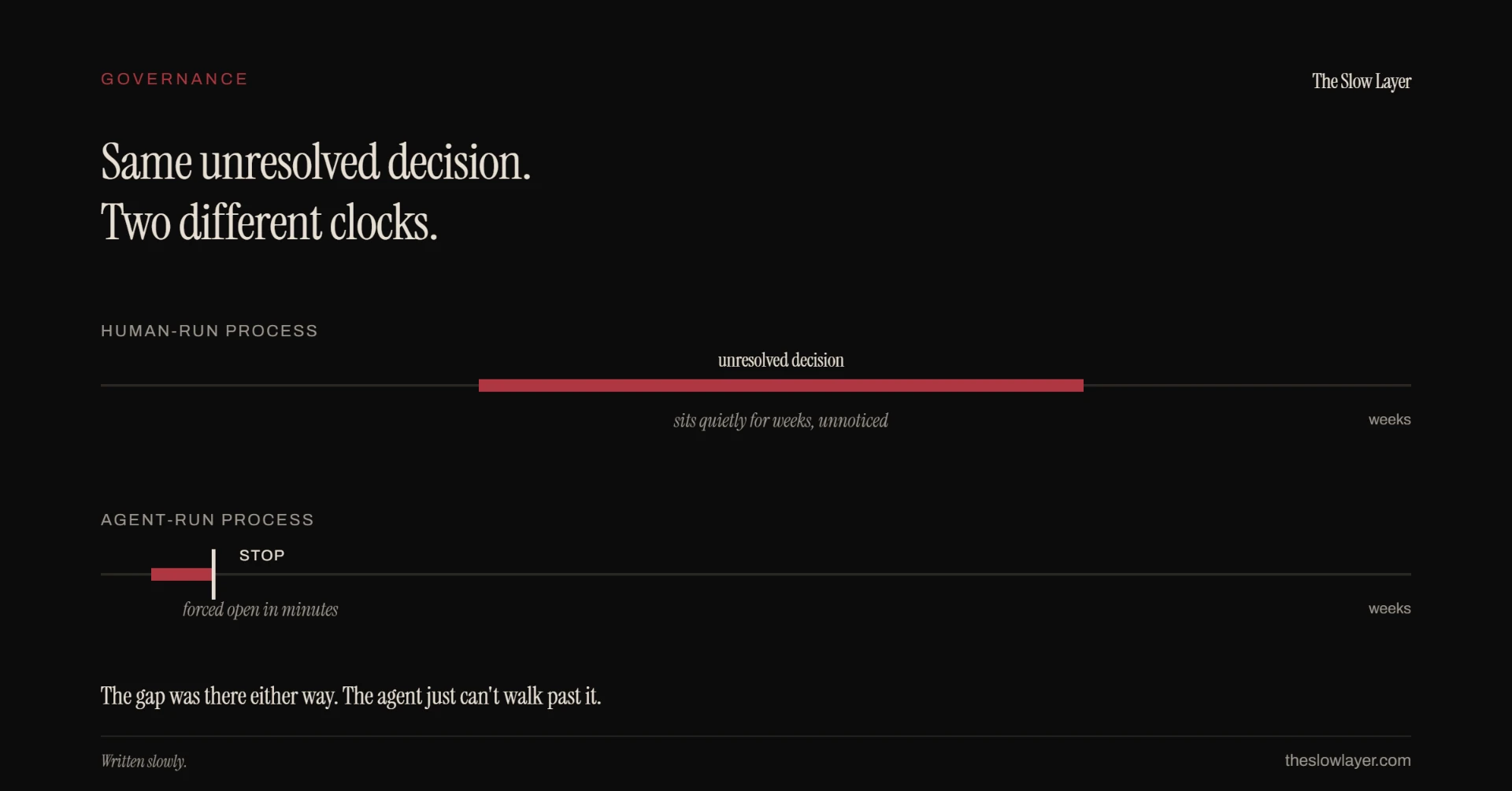
An agent can't route around an open question. It needs an answer to keep going: approve this, hold this, pick between these two paths. A Magic 8 Ball will at least give you "ask again later." Most agents don't ship with that setting.
Drop one into a process where decision rights were left undefined, and one of two things happens.
Either it stalls, waiting on a human who may not know they're the human it's waiting on. Or it fills the gap with its own guess and keeps moving. The second one is the dangerous one, because a guess that produces an action looks exactly like a decision in every log, dashboard, and status report downstream. The organization sees progress. It doesn't see that a question it hadn't answered just got answered on its behalf.
Neither outcome is the agent's fault.
That's the part that gets missed in most conversations about agentic risk. Speed is the exposure mechanism, and it's easy to mistake it for the cause. The same ambiguity that could sit unnoticed for a quarter inside a human-run process now surfaces in the time it takes an agent to hit it, which is to say almost immediately, and often in the middle of something that was supposed to be running unattended.
The gap was there either way. The agent just can't walk past it.
The numbers say the same thing
It shows up at scale, and well beyond IT.
Gartner predicts that by 2030, half of AI agent deployment failures will come down to insufficient governance enforcement rather than the technology itself. McKinsey's 2026 survey of roughly 500 organizations found only about a third reporting real maturity in strategy, governance, and agentic AI governance, with nearly two-thirds naming security and risk as the top barrier to scaling, even as adoption keeps speeding up.
MIT Sloan Management Review, writing with executives at Liberty Mutual, Sanofi, and Mastercard, puts a name on the underlying tension: the "learning-authority dilemma," the moment when a system's judgment moves faster than the authority anyone formally gave it. Insurance, pharma, and payments show the same gap, measured across companies instead of inside one project.
Before the first agent
There's a plain piece of work worth doing before the first agent goes in, and it doesn't require a new committee or a platform purchase.
Look at where decisions in your organization already sit unresolved. Skip the dramatic ones and look at the ordinary ones that keep showing up as "parked" in meeting notes. For each, ask who actually owns it, what "decided" would look like, and how long it has been waiting.
That list is the one an agent will find for you anyway. The question is whether you'd rather read it now, on a slow afternoon, or have it read to you in production.
Which decisions in your organization are already unresolved?
Sources
- Gartner Announces Top Predictions for Data and Analytics in 2026, Gartner press release, March 11, 2026 www.gartner.com/en/newsroom/press-releases/2026-03-11-gartner-announces-top-predictions-for-data-and-analytics-in-2026
- State of AI trust in 2026: Shifting to the agentic era, McKinsey www.mckinsey.com/capabilities/tech-and-ai/our-insights/tech-forward/state-of-ai-trust-in-2026-shifting-to-the-agentic-era
- The Great Power Shift: How Intelligent Choice Architectures Rewrite Decision Rights, MIT Sloan Management Review with TCS sloanreview.mit.edu/article/the-great-power-shift-how-intelligent-choice-architectures-rewrite-decision-rights/
From the same thread
When the Seller Becomes the Advisor
Between May and July 2026, the companies that build the technology also became the ones paid to advise on it. I think that changes what a second opinion is worth.
Decision Authority, Earned in Steps.
What an agent can decide should depend on what it has demonstrated, how far mistakes can reach, and what can be reversed.