Governance · Part 2
Decision Authority, Earned in Steps.
What an agent can decide should depend on what it has demonstrated, how far mistakes can reach, and what can be reversed.
Shikhar Agarwal · October 18, 2026 · 3 min read
Most organizations wouldn’t hand a new agent the same authority they’d eventually trust it with. In practice, a lot of them do anyway, because the setting most agents ship with is binary: on or off, can act or can’t.
That’s a tooling default being mistaken for a governance decision. Worth taking apart.
How people earn trust
A new hire doesn’t get the keys to payroll in week one. You wouldn’t do the office trust fall with someone you met five minutes ago either, no matter how reassuring they sound. Trust gets built from small decisions handled well, then bigger ones, with enough time in between to notice if something went wrong.
Organizations already run on this. Spending limits rise with tenure. Approval thresholds scale with seniority. Junior staff draft, seniors sign. The gradient is so familiar that it mostly goes unwritten, which is fine for people, because managers carry it in their heads.
It’s not fine for software, because an agent needs explicit boundaries for what it can decide.
The staircase most companies haven’t drawn
Here’s what the gradient looks like when you draw it for an agent. Five steps, each a real change in what the system is allowed to do without a person in the loop:
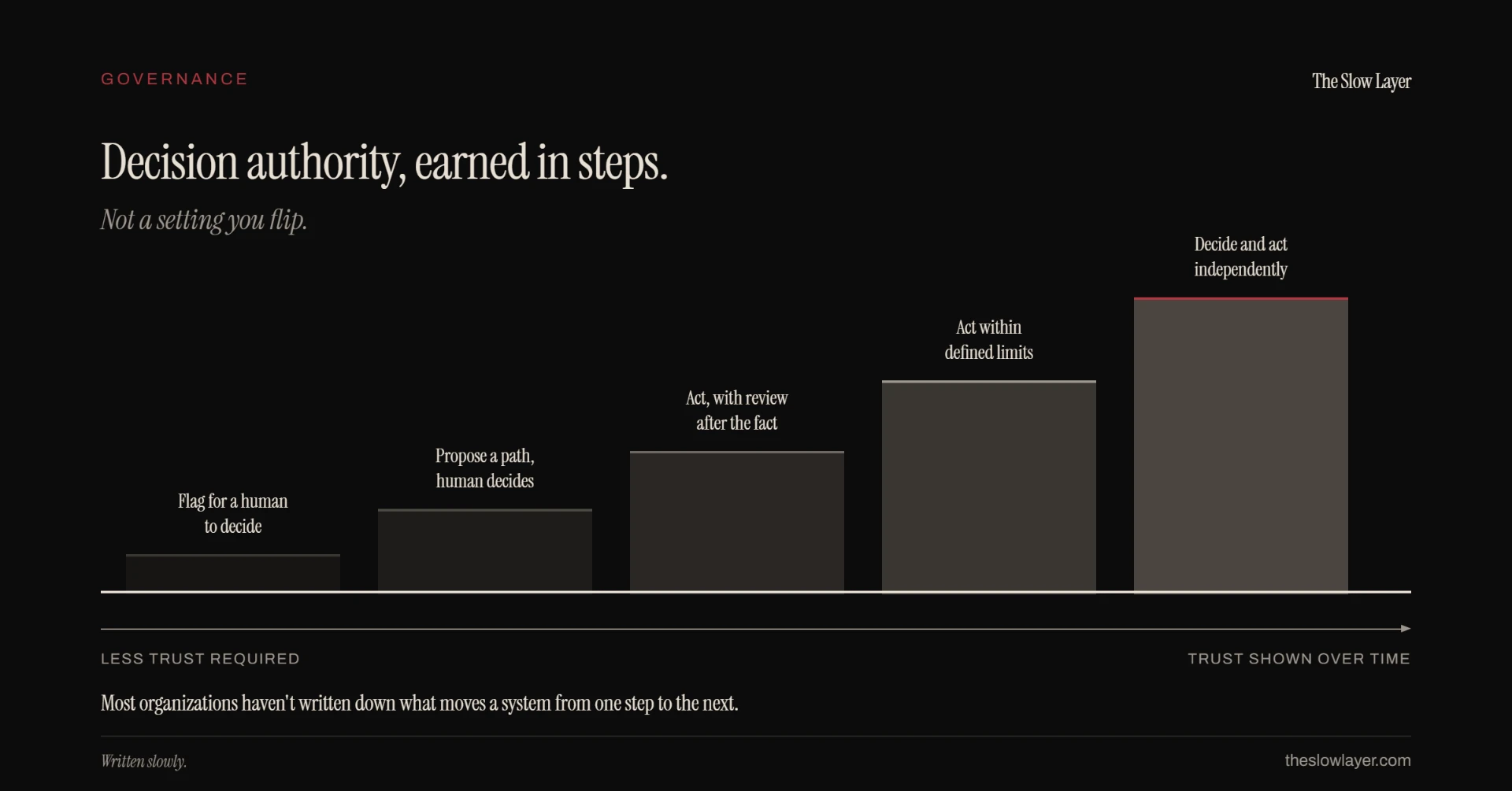
- Flag for a human to decide. The agent notices and routes. It doesn’t make the final decision.
- Propose a path, human decides. The agent recommends, with its reasoning. A person approves or rejects.
- Act, with review after the fact. The agent executes, and a person checks a sample or a log within a defined window.
- Act within defined limits. The agent executes on its own inside explicit boundaries: amounts, categories, customers, time of day. Review continues within an agreed window.
- Decide and act independently. The agent owns the decision end to end within an agreed scope, with monitoring rather than routine review. The limits and escalation rules still apply.
An on/off setting leaves the middle steps undefined. The middle steps make authority easier to test and adjust.
What moves a system up a step
This is where the gradient has to get specific, because the bar shouldn’t be the same for every kind of decision. Approving a $40 refund and approving a $40,000 contract change look identical to a system built only to say yes or no, even though the risk behind them isn’t close.
Three things tend to decide how high the bar sits. Reversibility: a decision that can be undone in an hour earns autonomy faster than one that can’t be undone at all. Blast radius: one customer, one team, or the whole book of business. Evidence: how many decisions the agent has made at the current step, over how long, and what the review found.
Two things usually get left out and shouldn’t be. First, demotion. If an agent at step four breaches an agreed threshold for errors or exceptions, it should drop to step three without a committee meeting. Second, decay. Trust earned on last quarter’s data and last quarter’s rules shouldn’t carry forward untouched when either one changes.
The gradient is a record of decisions made well, not a setting you flip.
What a workable framework needs
Less than people expect. A short list of what the agent can decide alone right now. What still needs a person. What it would need to show, over what stretch of time, before that list grows. Who’s allowed to change the list, and where it lives so the next person can find it.
The list can be short. Agreeing on it takes work. Most of it just hasn’t been written down yet, because the on/off switch made it feel unnecessary.
The question
Is there an actual gradient for how much your agents have to earn before they get to decide more on their own, or is it still just on or off?
From the same thread
When the Seller Becomes the Advisor
Between May and July 2026, the companies that build the technology also became the ones paid to advise on it. I think that changes what a second opinion is worth.
Same Unresolved Decision. Two Different Clocks.
Agents can't let an old, unresolved decision sit. The same ambiguity that waited months now surfaces in minutes.